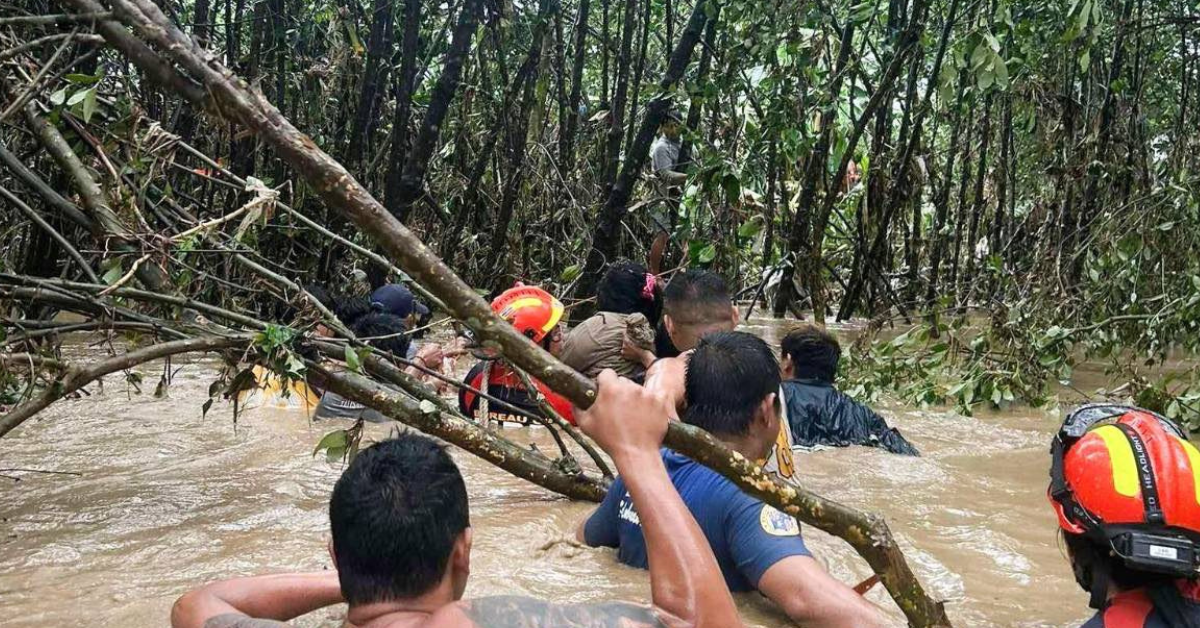
President Ferdinand Marcos Jr. has approved the declaration of a national state of calamity following the widespread destruction caused by Typhoon Tino, which ravaged large parts of the Visayas and Mimaropa regions, leaving hundreds dead and missing. Speaking after a situation briefing at the National Disaster Risk Reduction and Management Council (NDRRMC) headquarters on Thursday, November 6, the President said the declaration would enable faster access to emergency funds and streamline the procurement of relief goods. "Because of the scope of problem areas that have been hit by Tino and will be hit by Uwan, there was a proposal from the NDRRMC—which I approved—we will declare a national calamity," Marcos said. "Almost 10 to 12 regions will be affected. We are continuing our relief support for those who were hit by Typhoon Tino," Marcos said. The President said both national and local governments, along with first responders, are continuing relief and rescue operations to assist displaced families. The President also raised concern over Typhoon Uwan, which is expected to bring stronger winds and heavy rains to northern Luzon, including Cagayan province. "Unfortunately, there’s another incoming storm named Uwan, which could be even stronger, so we are preparing for that," he said. Marcos added that the government is considering redeploying personnel and resources from the Visayas to northern Luzon to reinforce disaster preparedness efforts. "We have to determine how many personnel can be redeployed to prepare for Uwan," he noted. The President said authorities are still validating the extent of the damage, including the number of casualties and evacuees. "With that kind of scope, it qualifies as a national calamity," he added. Marcos explained that the measure would ensure quicker mobilization of government resources and faster procurement procedures, allowing agencies to respond more efficiently to the needs of affected communities. According to the Office of Civil Defense (OCD), as of Thursday morning, November 6, the death toll from Typhoon Tino has risen to 114, with 127 people still missing. Many displaced residents are temporarily staying with relatives instead of evacuation centers, he added. "Those are still being processed, but it is a significant number." Despite the devastation, the President assured the public that the government remains focused on both relief efforts and preventive measures ahead of Typhoon Uwan’s landfall. "If we anticipate well and prepare well, we can do much to lessen the impact," he said.