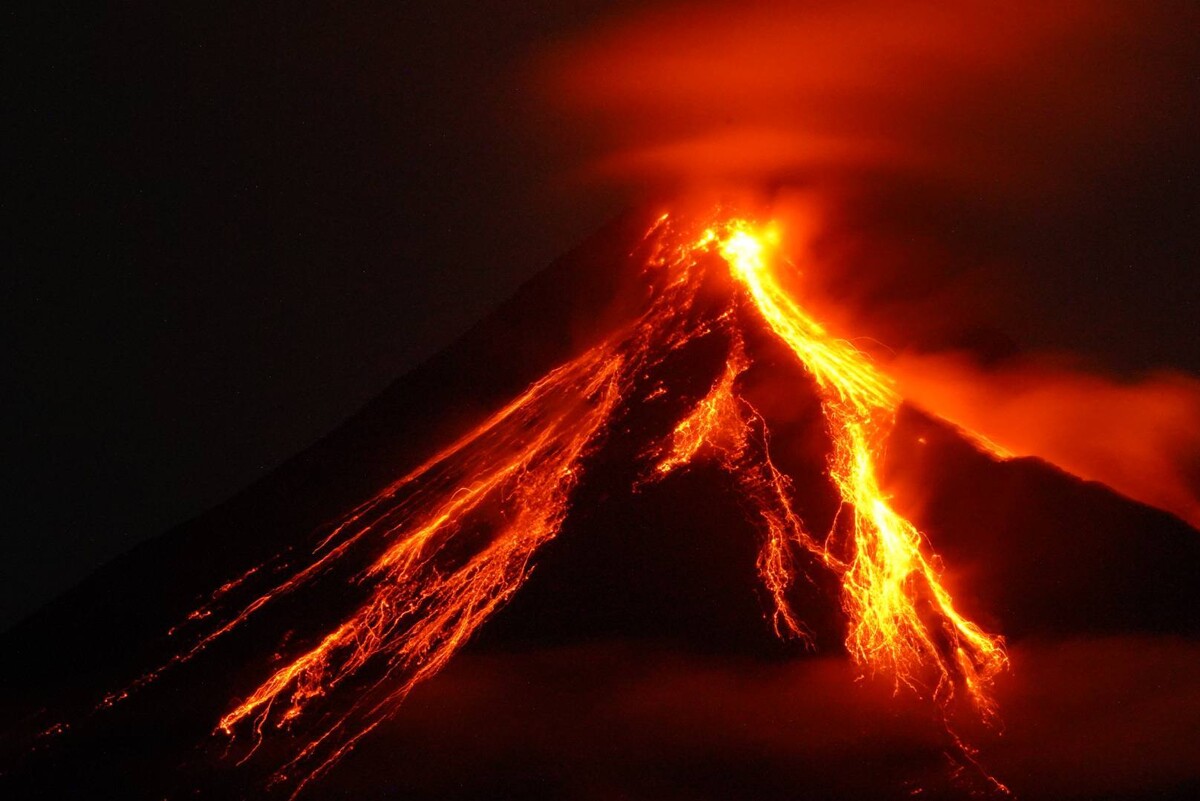
The Philippine Institute of Volcanology and Seismology (PHIVOLCS) reported a noticeable increase in seismic energy at Mayon Volcano on Sunday, January 11, even as the volcano remains under Alert Level 3 due to ongoing pyroclastic density currents (PDCs). According to PHIVOLCS, real-time seismic amplitude measurements (RSAM) showed a marked rise beginning Sunday, detected by six out of the 16 monitoring stations surrounding Mayon. The increase was attributed to sustained volcanic tremor rather than fresh volcanic earthquakes, suggesting that the volcano’s vent remains fully open while lava continues to erupt effusively. Despite the heightened seismic activity, state volcanologists clarified that there has been no corresponding increase in ground deformation or swelling, indicating that magma pressure has not significantly intensified at this stage. PHIVOLCS earlier recorded intense surface activity at the volcano, including 256 rockfall events and 41 instances of PDCs—locally known as “uson”—within a 24-hour period. Residents living within the eight-kilometer radius were advised to stay alert and prepare for possible evacuation should conditions escalate to Alert Level 4. PHIVOLCS emphasized that pyroclastic density currents—fast-moving mixtures of volcanic debris, ash, and superheated gas—are among the most dangerous volcanic hazards and pose a severe risk to life and property. Sulfur dioxide emissions also remained close to baseline levels, averaging 777 tonnes per day as of January 10. Authorities reiterated that entry into the six-kilometer Permanent Danger Zone remains strictly prohibited due to the threat posed by lava flows, rockfalls, and extremely hot PDCs, which can reach temperatures of up to 1,000 degrees Celsius.