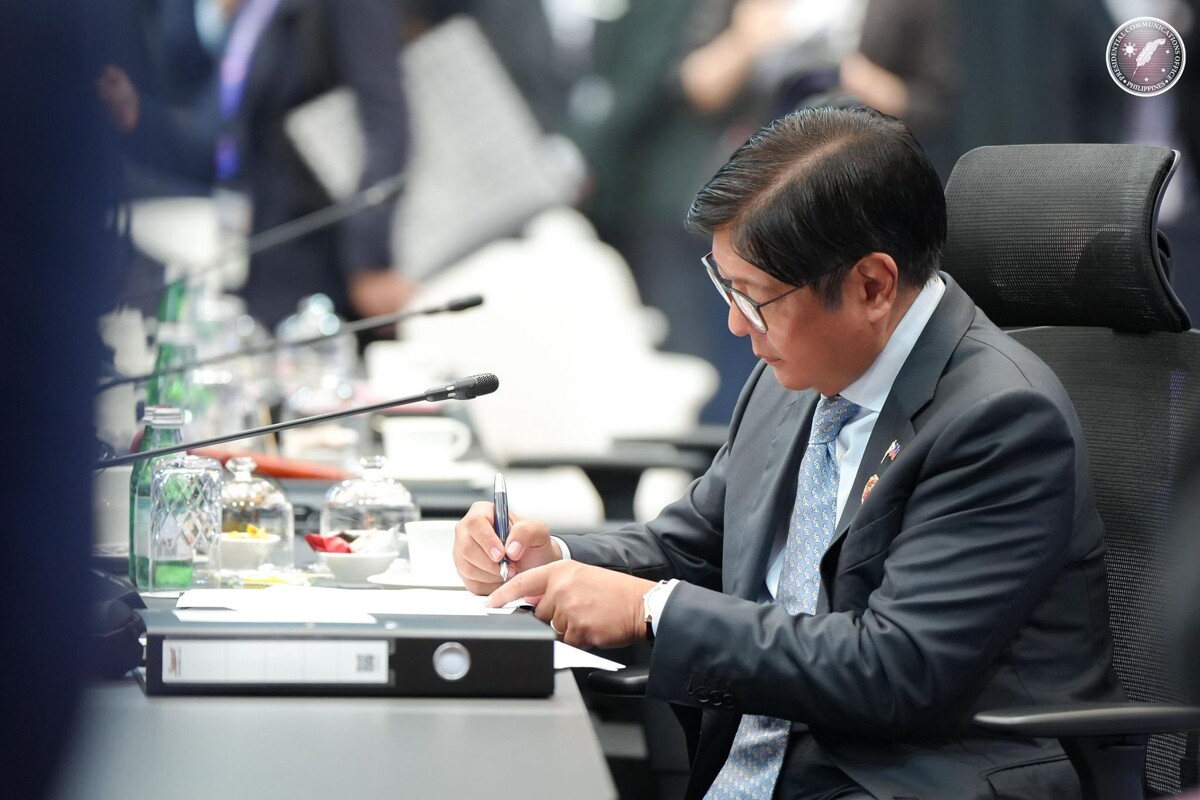
President Ferdinand R. Marcos Jr. vowed that corrupt officials would be jailed and stolen public funds recovered, while stressing that the government’s anti-corruption drive must strictly follow due process to prevent cases from collapsing in court.
"So let’s make sure they really get jailed and their stolen funds are returned to the government, to the people," Marcos said, underscoring the importance of airtight evidence in ensuring successful prosecutions.
Speaking to reporters after the ASEAN Summit in Kuala Lumpur, the President acknowledged public frustration from labor and business groups over the slow pace of corruption investigations but warned against rushing cases without sufficient proof.
"I get messages all day, every day: ‘Jail them now!’ But we cannot waste that opportunity to bring those people to justice and to bring justice to the Filipino people."
The President admitted that building strong cases takes time, especially when witnesses are hesitant to cooperate. "Those decisions have to be left to them."
He added that he is open to transparency measures, including livestreaming ICI hearings, but said the decision should come from the commission itself. "The ICI just needs to finalize its rules so everyone understands the best way to proceed," Marcos said.
Earlier, major business and labor groups—including the Employers Confederation of the Philippines (ECOP), Philippine Chamber of Commerce and Industry (PCCI), and Trade Union Congress of the Philippines (TUCP)—criticized the government for what they described as a lack of visible progress in prosecuting corruption cases.
In a joint letter, they warned that "trillions have already been stolen from public coffers" and urged the President to prove that his anti-corruption campaign "is not another soundbite for selective justice."
Marcos said he understood the impatience but urged patience with the legal process.
"So, do you want to get it done quickly or do you want to get it done right?" he said. "So we have to extract that information and turn it into evidence that will hold in court."
Asked about Senate Bill 1215, which seeks to establish an Independent People’s Commission to investigate corruption, Marcos said that existing mechanisms—such as the Independent Commission on Infrastructure (ICI)—should be allowed to perform their mandate first.
"We are making sure that they are truly independent," he said. "If we create another body that will just duplicate their functions, it will lead to chaos. That would be a much worse result."
Marcos said the government’s anti-corruption campaign has now shifted "from the political arena to the legal one," where evidence and due process determine success.
"We only get one chance at this," he said. "If we rush cases and the evidence is weak, and they get acquitted on a technicality — can you imagine people who have stolen billions getting away because the evidence was poorly handled?"
He cited examples of the difficulties in building cases: "Some witnesses hide the truth. Some withhold information. The law grinds very slowly, but it grinds very well."
In response to calls for more decisive action, Marcos drew an analogy: "Sell their houses. Take all their money. Take all their properties. But what would I be accused of if we did that? It’s not easy to do that," he said.
He emphasized that the government provides the commission with a budget and allows it to run everything the way it wants.
"That’s the choice that we have. Either we operate within the law, or we break the law. If we break the law, we become just like them. That would be a much worse result," he concluded. "The law grinds very slowly, but it grinds very well."