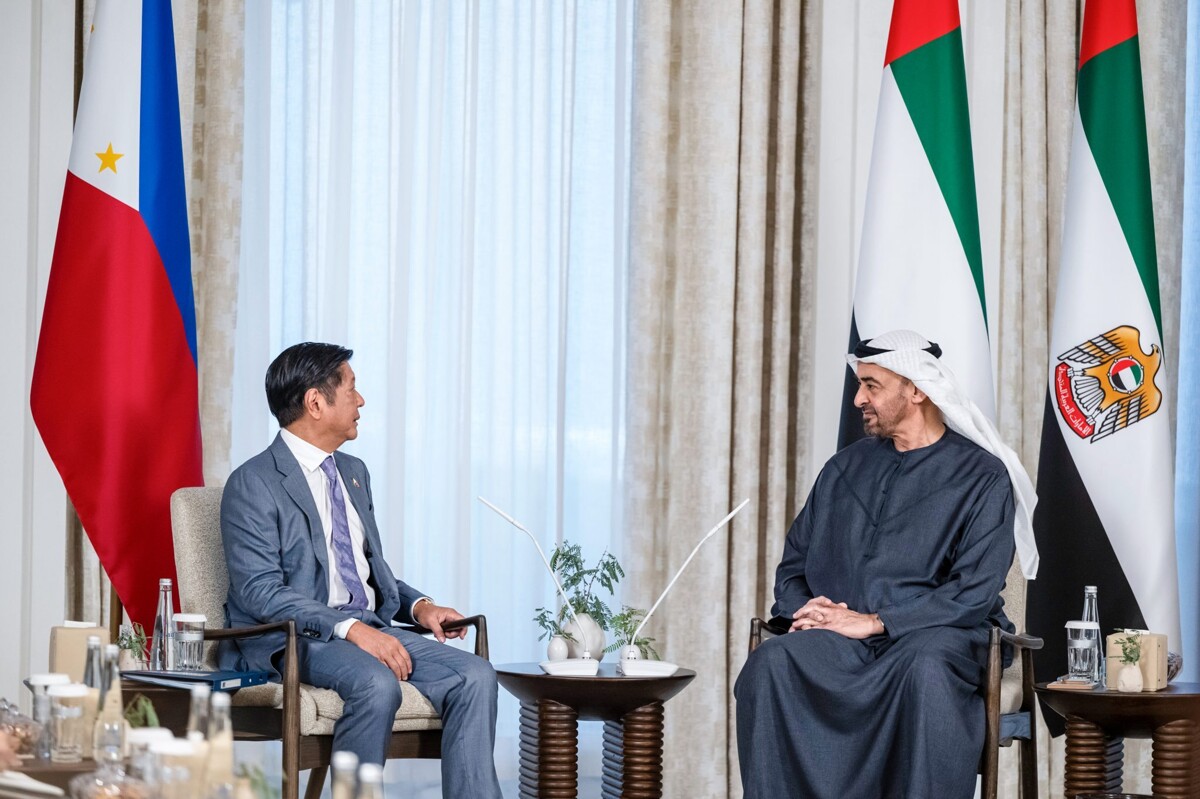
President Ferdinand Marcos Jr. has departed for a working visit to the United Arab Emirates to finalize two major agreements aimed at boosting economic ties and defense cooperation, while also participating in the Abu Dhabi Sustainability Week. The visit comes upon the invitation of UAE President Sheikh Mohamed bin Zayed Al Nahyan and will see the signing of the Comprehensive Economic Partnership Agreement (CEPA) and a Memorandum of Understanding on Defense Cooperation. Marcos said the agreements reflect the deepening partnership between the two nations, noting that CEPA will become the Philippines’ first free trade agreement with a Middle Eastern country—opening wider market access across the Gulf region. "It has been 15 years since the last visit," Ambassador Ver said in an interview with RTVM. During the official visit, Marcos is set to sign the Comprehensive Economic Partnership Agreement (CEPA) and a Memorandum of Understanding (MOU) on Defense Cooperation with the UAE. He will also be attending the Abu Dhabi Sustainability Week, an annual global forum that brings together world leaders to discuss climate change, renewable energy and sustainable economies. The ambassador said the Philippines’ participation is crucial, as it remains among the countries most vulnerable to the effects of climate change. "They say we're one of the most vulnerable countries to climate change," he added. He noted that stronger bilateral cooperation would benefit both overseas Filipinos and those back home. Marcos will also join fellow world leaders at Abu Dhabi Sustainability Week, where discussions will focus on global challenges involving energy, water, food security, finance, and the environment. "And it just goes to show, our relations here are changing too," Ambassador Ver said. CEPA is expected to open opportunities not only in trade but also in professional mobility, investments and services, and serve as a gateway to the broader Gulf Cooperation Council market, which includes Saudi Arabia, Oman, Qatar and Kuwait, he added. The Philippines and the UAE officially announced the start of talks on the free-trade agreement in 2022, with formal negotiations beginning in May 2024. The defense MOU, meanwhile, is expected to enhance collaboration in advanced defense technologies. The President highlighted the importance of the UAE to the Philippines, citing the nearly 900,000 Filipinos living and working there. UAE firms have expressed interest in projects in the Philippines, ranging from energy and data centers to land development. "With the CEPA and everything, it will open so many doors and will really bring more investors, more interest back to the Philippines," he added. President Ferdinand Marcos Jr.’s official visit to the United Arab Emirates this week marks a significant shift in Philippine-UAE relations, with major trade and defense agreements set to be signed, underscoring closer political and economic ties between the two countries. Philippine Ambassador to the UAE Alfonso Ferdinand Ver said the upcoming visit reflects how relations between the two countries have changed, noting that it took 15 years before a presidential visit happened prior to November 2024. "This is the second (visit) in about 14 months since November 2024." In 2025, the two countries concluded discussions on key provisions, finalized legal reviews, and prepared for the signing of the Comprehensive Economic Partnership Agreement, which is scheduled for January 2026. Defense cooperation Alongside CEPA, Marcos is also expected to witness the signing of a memorandum of understanding on defense cooperation. Ambassador Ver said the agreement will allow for training, exchanges and information-sharing, particularly in areas such as counterterrorism and transnational crime. Ver added that relations between the two countries are now expanding into previously untapped sectors, including renewable energy, artificial intelligence and the digital economy. "To share and also to showcase what we are doing," he added. Around 14 heads of state are expected to attend the forum, which Ver described as a key platform for advancing cooperation in renewable energy and sustainability—areas that are also priorities for the Philippine government. Free-trade agreement A major highlight of the visit will be the signing of CEPA, which will be the Philippines’ first free trade agreement with a Middle Eastern country. The deal aims to expand market access for Philippine goods and services and deepen investment ties with the UAE and the wider Gulf region. "We were one of the very first countries to be offered to conclude this agreement." He said the Philippines is eager to contribute to—and learn from—collective efforts toward a more sustainable future. "So in a short span of time, they have met twice with His Highness, the President Sheikh Mohammed Bin Zayed Al Nahyan, the President of the UAE. So we need all the help that we can get. And finally, we're doing it. But aside from that, we're also here to share what we know."